I read somewhere that King Kong is one of cinema’s most enduring mythic figures because the character functions as a Rorschach test for us. The same story is experienced differently by each of us. With that in mind, I offer the following.
Kong holds a special place in my cinematic imagination. Each time I watch one of the four versions I return to—1933, 1976, 2005, and 2017—Kong is the center of my emotional attention. Everyone else is there to play an allotted role in Kong’s story.
Then something unexpected happened while I was watching the end of the 1976 version.
Perhaps recently watching Kong: Skull Island (2017), and seeing all the ways it subverts the original, opened me to recognizing how the 1976 ending subverts the female roles in the other three versions. Both the 1933 and 2005 films leave Ann Darrow with Jack Driscoll, while the 2017 version leaves Mason Weaver and James Conrad surviving together.
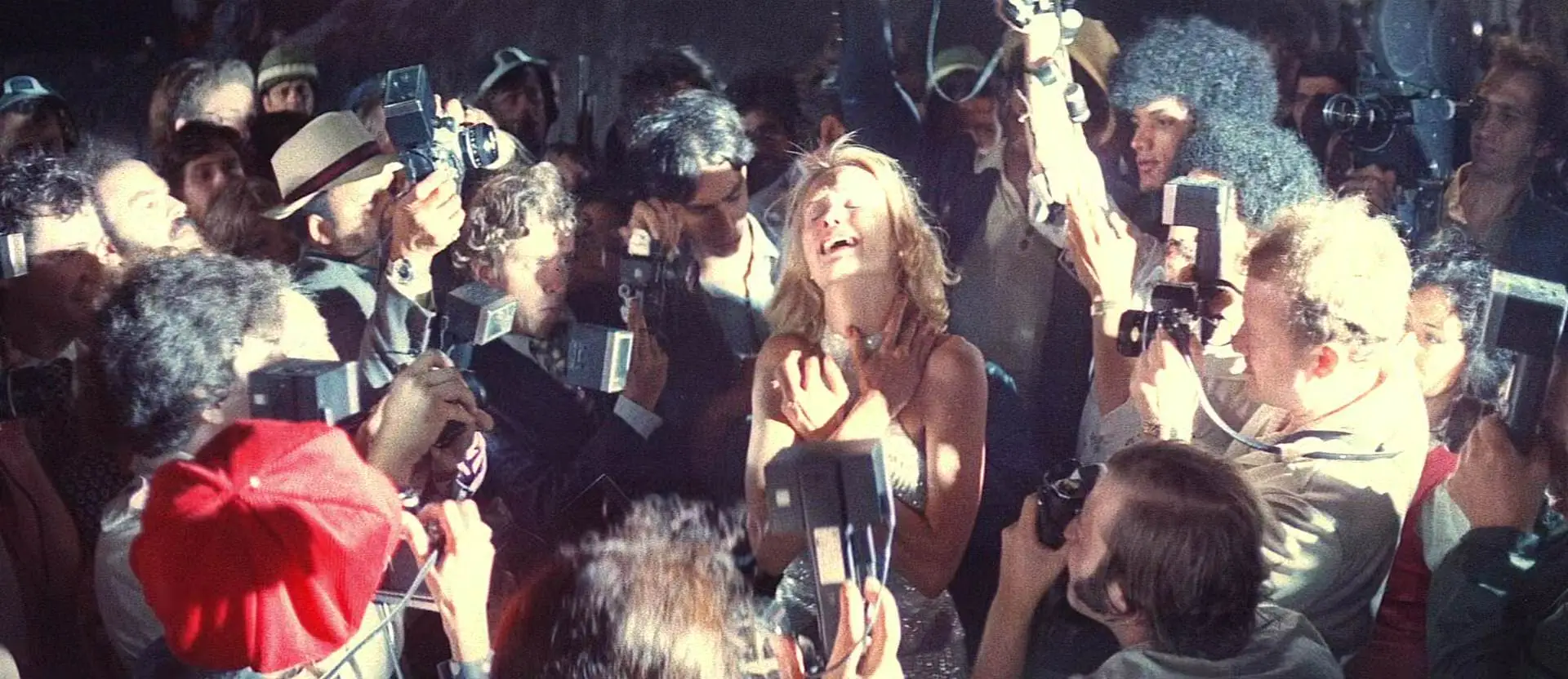
The 1976 ending changes that trajectory. The movie doesn’t end with Kong’s death—or with Dwan finding a happy ending with Jack Prescott. It ends with Dwan’s story left dangling.
What?
Because the original is so deeply embedded in me, I began the 1976 film expecting Kong to be its emotional center and expecting his death to be its completing moment. The film allows that expectation to run its course. Then, quietly and almost brutally, its final moments reveal that Kong’s death is the penultimate emotional beat, not the final one.
Dwan’s abandonment by Jack Prescott is the final beat.
Dwan’s last cry is not for Kong but for Jack. At that instant, the emotional axis of the film shifts. Kong’s death becomes one more overwhelming experience in Dwan’s life rather than the culmination of the film. Suddenly and unexpectedly, she is revealed as having been its emotional center since she first appeared in the middle of the Pacific Ocean on a life raft.
Dwan enters the story alone, discovered aboard a life raft in the middle of the Pacific.
She is eccentric, talkative, imaginative, and oddly accepting of the extraordinary events unfolding around her. Then Jack enters her story and offers her the possibility of sharing her life with another person. She wants it all: a life in the spotlight and a happy ending with Jack, like the two Anns—and perhaps Mason Weaver—found in their respective stories.
But Jack is conflicted. At the moment Dwan cries out to him, he abandons her.
His turning away from Dwan cuts deeply. It is a failure of recognition and imagination. Jack no longer sees the woman with whom he has fallen in love. In the end, he can see Dwan only as someone too exotic for a university common room.
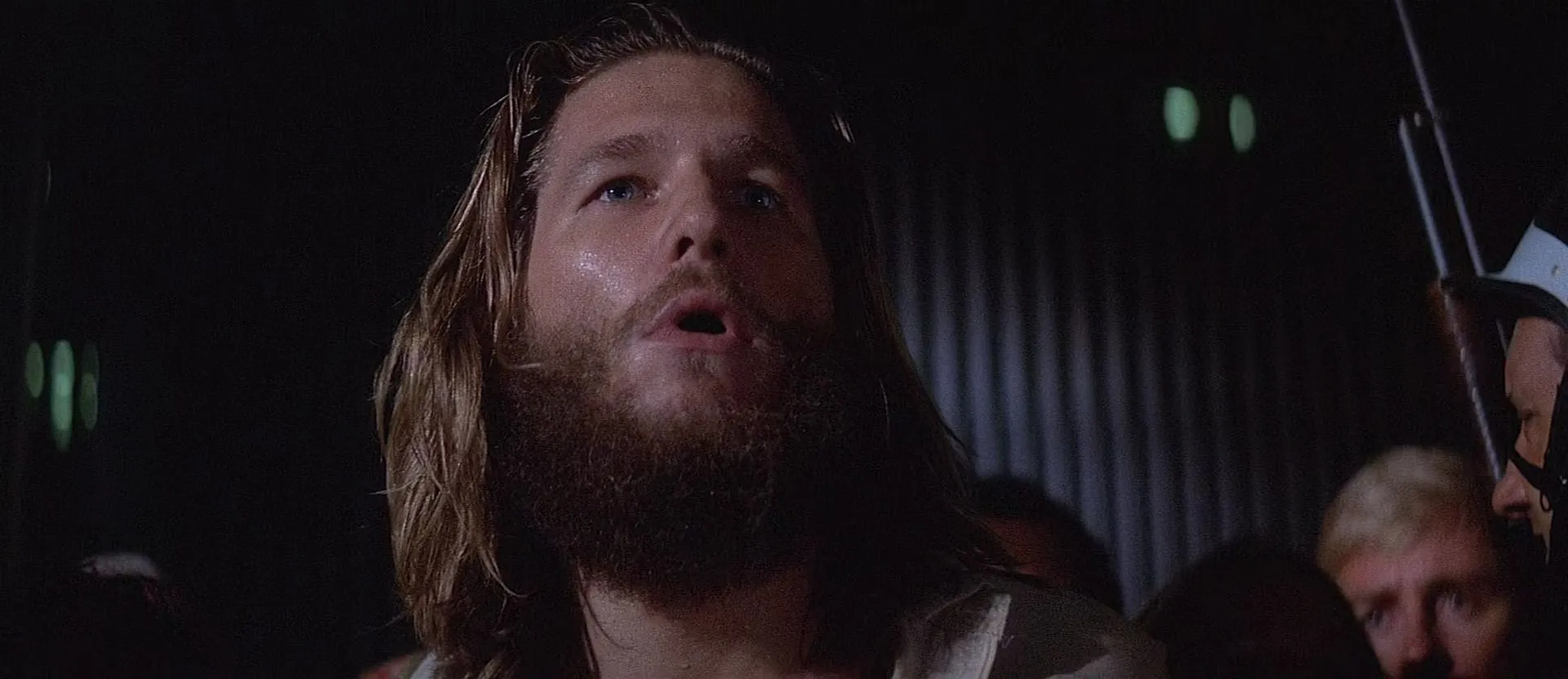
Jack watches from outside the crowd as Dwan’s tragedy unfolds.
That leaves Dwan to continue surviving as best she can in a world of men with predatory power: her agent on the yacht, Fred Wilson, and the mayor of New York City. That is her tragedy.
At that moment, Kong’s tragic ending is pushed into the background to make room for what has been Dwan’s story all along. Through Jessica Lange’s brilliant performance, Dwan’s survival becomes the poignant ending the movie leaves with us.
The 1976 version may have understood something the other versions did not: that the “girl’s” story can be the more honest center for some of us to be left with—even more than Kong’s.
After seeing this, I watched the theatrical and television cuts again. Both flowed wonderfully and honestly when I viewed Dwan as the center. Whether planned or accidental, the 1976 ending coheres. It isn’t a loose thread or a tonal mistake. Once seen, it retrospectively organizes the entire film around Dwan’s tragedy in a way that feels inevitable.
That said, I am still moved—and will always be moved—by Kong’s story in all four versions. But now I keep in the back of my mind how Hollywood loves to give us tragic endings so that we can cry, feel cleansed, and then go to sleep comforted by our own empathy.
For some reason, this version offers us something far more demanding: unresolved tension and moral confrontation.
Unless I am missing something, the 1976 King Kong offers us both.
Castle Howard, which represented Brideshead in the 1981 television series and the 2008 film. Photograph: Benjamin Smith/Wikimedia Commons, CC BY-SA 4.0.
Brideshead Revisited helped reconcile me to the Catholic roots of my infant baptism. Through Evelyn Waugh’s 1945 novel, the 1981 television miniseries, and the 2008 film, I found a story that addresses love, heartbreak, suffering, free will, death, and unintentional cruelty—the stuff of life. Together, these versions gave me words and images that helped anchor my wandering ways.
What draws me into the world of Brideshead is its complexity. The story does not hand us a single, comfortable interpretation. It leaves clues and asks us to decide what they mean.
Charles Ryder narrates the story while looking back on his involvement with the Flytes, an aristocratic Catholic family he first encounters as an agnostic. By the time he tells the story, he appears to have entered the Catholic faith himself, yet he is hardly flourishing. He is isolated, emotionally exhausted, and serving in a world at war. Conversion has not magically solved his life.
That tension matters. Brideshead Revisited is not a simple advertisement for Catholicism. It portrays faith as something capable of offering meaning and mercy, while also becoming entangled with guilt, family pressure, and suffering.
Grace Among Imperfect People
In the preface to his 1960 revision, Waugh described his subject as “the operation of divine grace on a group of diverse but closely connected characters.” Yet these are not conventional saints. They are wounded and frequently self-destructive people whose lives do not offer tidy moral lessons.
That is precisely why they matter to me. I am not one of the heroic saints whose stories the Church retells for the encouragement of the faithful. I am one of billions of Catholics living what might be called an ordinary life from birth to death. The people in Brideshead look more like me than those idealized models often do.
I first became enamored with Brideshead after seeing the 2008 film. Since then, I have revisited the story in nearly all its forms: the film, the miniseries, the novel, criticism, essays, and even fan fiction. But only years later did the story change my life.
While watching Lord Marchmain’s deathbed scene, I understood why I needed to re-embrace the Catholic community from which I had felt estranged for roughly a decade. Like Marchmain, I had rejected much of the Church’s theology and ceased participating in many of its rituals. In important ways, I still struggle with both.
What changed was not my acceptance of every doctrine or practice. I became reconciled instead to what I experienced as the Church’s motherly love. I felt that I had returned to my spiritual home. The peace I experienced was both understandable and mysterious. It was not a conclusion reached entirely through reason. It felt more like grace.
What Does Charles Ryder Really Want?
Charles is captivated not only by Sebastian and Julia, but by everything Brideshead represents: beauty, history, belonging, family, and a world from which he feels excluded. Julia eventually asks the essential question: “What does Charles Ryder really want?”
His answer, in effect, is that he wanted to become part of the dream. He was willing to endure humiliation for admission into that world. He never fully receives what he desired. Sebastian disappears from his life, Julia leaves him, and Brideshead itself becomes a military encampment.
Yet Charles gains something unexpected: the faith that belonged to Sebastian and Julia. By embracing Catholicism, he can continue loving them through the one part of their lives he had been unable to share. As long as he judged their faith only from the outside, a distance remained between them that could never be crossed.
Why would he embrace a religion he believed had caused them so much suffering? Love is not always logical. Perhaps Charles finally understood that their Catholicism was not an accessory that could be separated from the rest of who they were. It had shaped their imaginations, their guilt, their choices, and their hopes. To share their faith was, in some fashion, to remain connected to them.
That choice also had a price. Charles inherited something of the guilt carried by Sebastian and Julia. His conversion did not erase loss, nor did it restore the people he loved. It allowed him to see them—and perhaps himself—differently.
Charles and Sebastian: Against the World
Sebastian’s estrangement from his family is apparent from the moment he first brings Charles to Brideshead. The estate is where his family lives, but he does not describe it as his home. He visits his beloved childhood nanny while avoiding his mother. Before they leave, he shows Charles the chapel—the center of a faith that has become inseparable from his pain.
Charles and Sebastian recognize one another as outsiders. Charles lacks the family and inherited world that Sebastian possesses but cannot inhabit comfortably. Sebastian offers Charles companionship; Charles offers Sebastian a temporary escape from the expectations of his family. Together they become contra mundum—against the world.
Lady Marchmain’s love for Sebastian is real, but it is mixed with religious pressure. She wants him to become the Catholic son she believes he ought to be. Her concern is expressed through expectations he experiences as suffocating. His drinking, flight, and self-destruction cannot be reduced to one cause, but the collision between his nature and his family’s demands is central to his suffering.
When Charles later finds Sebastian ill in Morocco, their friendship is effectively ending. Sebastian will not return to Brideshead, and Charles cannot rescue him. Sebastian has begun to understand that no human relationship can carry the weight he placed upon theirs.
An imagined cloister garden inspired by Cordelia’s description of Sebastian’s life near a monastery. Original illustration created for Mikey’s Mullings.
Years later, Cordelia tells Charles that Sebastian lives near a monastery, never fully inside or outside its community. He remains impaired by alcoholism and dependent upon the kindness of others, yet she sees a kind of holiness in him. Her startling conclusion is that “no one is truly holy without suffering.”
That statement is the great hook in Brideshead for me. Everything seems to revolve around it. What does it mean to connect suffering with holiness? Should suffering be accepted, neutralized, or overcome? Is there ever value in it, or do we merely create meaning after the fact?
Waugh places universal human suffering beside the Catholic idea of Christ’s redemptive suffering. The result is disturbing as well as consoling. Some readers will see a dangerous glorification of pain; others will see the possibility that suffering need not be meaningless. I continue to live inside that question.
Charles and Julia: The Invisible Thread
In the novel and miniseries, Charles and Julia do not form a significant relationship until years after Lady Marchmain has driven him away. By then, both have married other people and neither is happy. Their affair returns Charles to the Flyte family and to Brideshead.
The 2008 film alters the chronology by establishing an earlier attraction between them, but each version reaches the same essential conflict. Julia believes that life with Charles might finally free her from the religious guilt planted in childhood. Returning to Brideshead, however, awakens the old voice that tells her she is living in sin.
She tries to leave that world behind, but Lord Marchmain’s return changes everything. As he lies dying, his final gesture of faith convinces Julia that she cannot permanently shut herself away from the possibility of divine mercy. She gives up Charles and the happiness they imagined together.
Can Charles let her go? Yes and no. With time, he can surrender the expectation of sharing a life with her. But he cannot discard what Julia, Sebastian, and Brideshead awakened in him without discarding part of what made him feel alive.
I believe Charles turns toward Catholicism partly to hold on to that connection. Julia and Sebastian become, in different ways, forerunners of God. He does not recover them, but he finally accepts the spiritual world that formed them.
The Flame in the Chapel
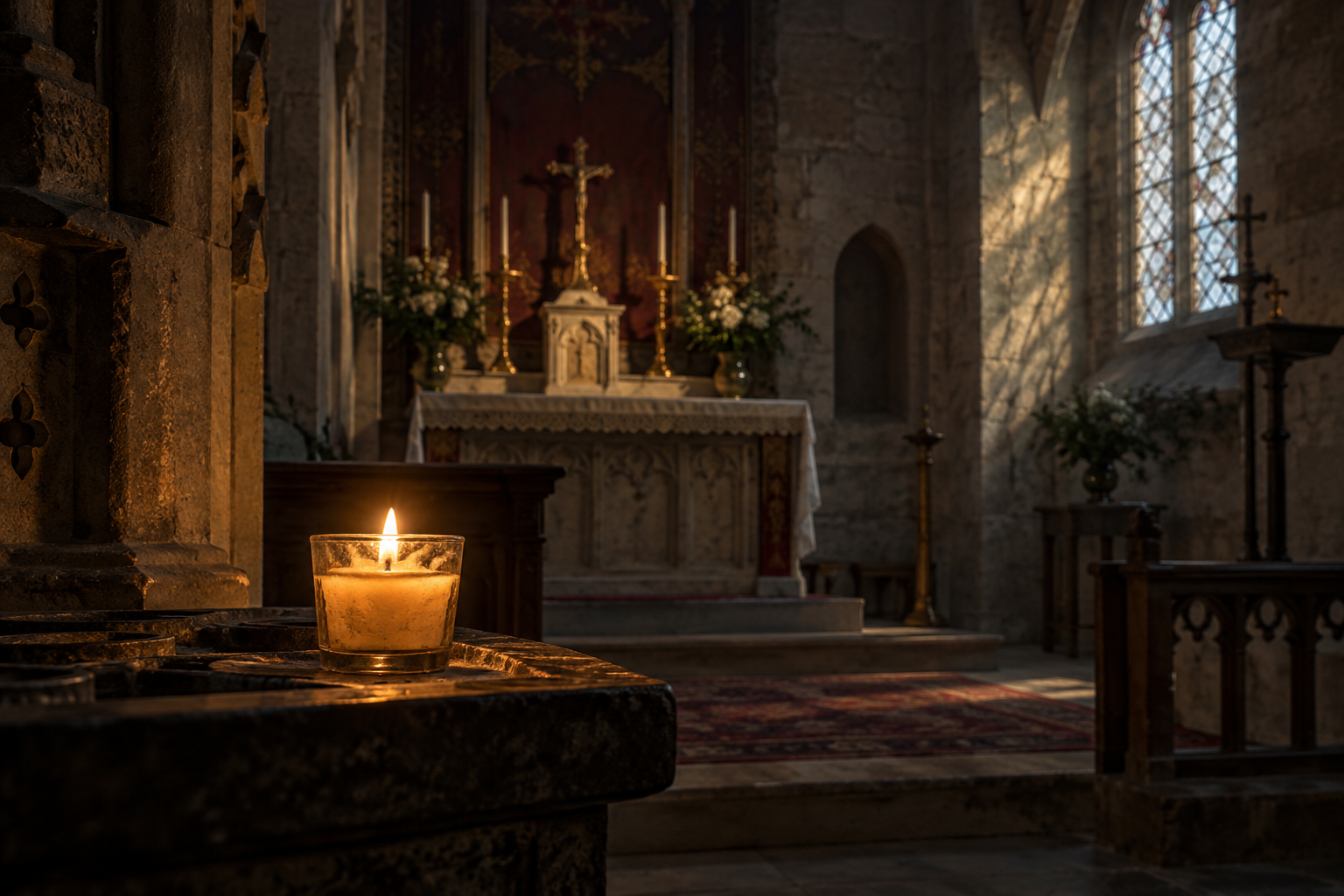
The enduring flame: an original illustration created for Mikey’s Mullings.
When Charles returns to Brideshead during the war, much of the dream has vanished. The estate has been repurposed, his relationships are gone, and the world around him is being destroyed. His conversion has not spared him from loneliness.
Yet the small flame in the chapel remains. Charles is tempted to extinguish it, as though he could finally end the hold that Brideshead and the Marchmains have upon him. He does not. By leaving the flame burning, he accepts that the past cannot simply be buried and that hope can survive in a diminished, mysterious form.
This does not erase the harm done to Sebastian or Julia. It does not transform their suffering into something simple or sentimental. Nor does it resolve every contradiction within Catholicism. Instead, it suggests that grace may continue working through damaged lives, failed relationships, compromised institutions, and incomplete understanding.
Why Brideshead Still Matters to Me
Brideshead Revisited matters to me because it tells the story of ordinary, imperfect people who are not saints in any conventional sense. Like me, they live within the helpful and harmful influences of Catholic tradition. They struggle, flee, wound one another, and reach toward mercy without fully understanding it.
Waugh leaves me with a question rather than an answer: Can there be a kind of holiness within our flawed and wounded lives?
That is a question I continue to ask myself. Brideshead Revisited gives me images through which to ask it—the outsider, the invisible thread, the deathbed gesture, the chapel, and the flame that remains. And so my pursuit continues.